
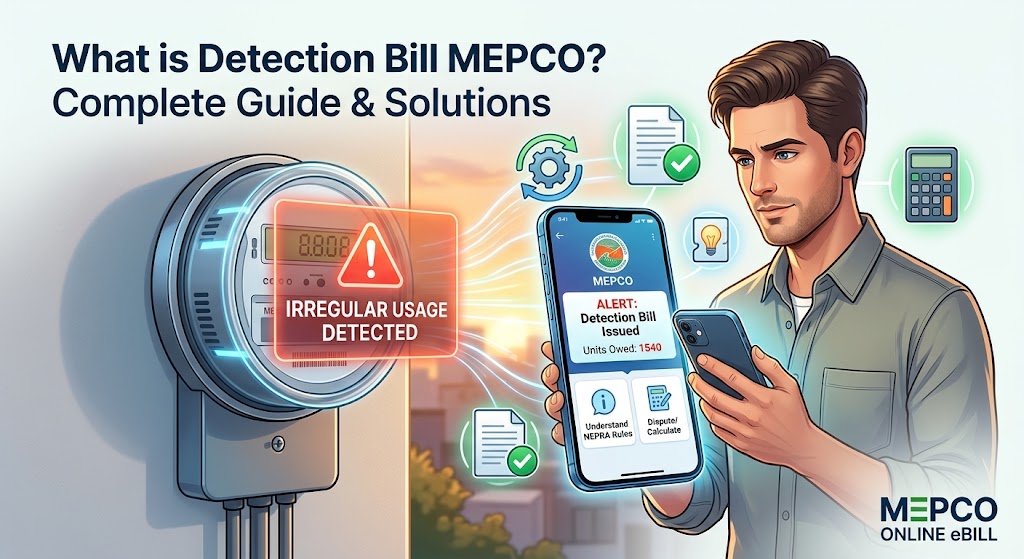
Managing monthly utility expenses is a critical priority for households and business owners across Pakistan. If you receive your monthly power bill from the Multan Electric Power Company (MEPCO) and suddenly notice an unusually high amount labeled under special charges, you might be looking at a detection bill. Understanding what is detection bill mepco and why it appears on your monthly statement can save you from unnecessary stress, unexpected financial strain, and potential legal disputes with the power distribution company.
A detection bill is fundamentally different from your standard monthly energy invoice. While regular bills reflect the precise kilowatt-hours (kWh) recorded by your meter during a specific reading cycle, a detection bill represents a penalty or compensatory charge added by MEPCO to recover unrecorded electricity usage. In this detailed guide, we will break down everything you need to know about detection billing, why MEPCO issues these charges, how the amounts are calculated under National Electric Power Regulatory Authority (NEPRA) regulations, and the exact steps you can take to dispute or resolve them.
What is Detection Bill MEPCO?
To understand what is detection bill mepco, it helps to look at how electricity distribution works behind the scenes. MEPCO is responsible for supplying electricity across thirteen districts in South Punjab. To maintain operational stability and ensure fair utility practices, MEPCO regularly inspects meters, lines, and connection points.
A detection bill is an additional bill charged to a consumer when MEPCO discovers that electricity was consumed without being properly registered on the energy meter. This situation typically occurs due to meter slowness, technical faults, direct supply connections (illegal hooking), or physical tampering with the meter device. When MEPCO identifies such irregularities, they issue a detection bill to recover the cost of the unbilled electricity consumed during the period the meter was inactive, slow, or bypassed.
Rather than serving as a standard bill for routine usage, a detection bill acts as an assessment of unrecorded power. NEPRA governs these billing practices through the Consumer Service Manual (CSM) to ensure that power distribution companies do not overcharge consumers while still protecting utility companies against revenue loss.
Common Reasons MEPCO Issues a Detection Bill
MEPCO does not issue detection bills arbitrarily; they are triggered by specific events identified during routine meter readings, site inspections, or automated monitoring systems. Here are the primary reasons why a consumer might receive a detection bill:
1. Slow or Faulty Meters
Over time, mechanical and electronic electricity meters can experience wear and tear. Technical glitches, faulty internal capacitors, or environmental damage can cause a meter to run slower than actual power consumption. When a MEPCO meter reader or inspection team conducts a check and discovers that the meter is registering fewer units than expected, the consumer is billed for the undetected units.
2. Dead or Stopped Meters
If a meter completely stops registering unit consumption while the property continues to receive power, the status is flagged as “dead” or “stopped.” Because energy was consumed during this period without record, MEPCO issues a detection bill based on historical consumption patterns to cover the unrecorded energy usage.
3. Direct Electricity Hooking (Kunda System)
Using direct wires bypassing the energy meter—commonly referred to as direct hooking or the “Kunda” system—is illegal under Pakistani law. If an inspection team discovers direct wiring supplying electricity to a property, the connection is disconnected immediately, and a detection bill along with legal penalties is slapped on the offender.
4. Meter Tampering and Seal Tampering
Any unauthorized physical alteration to the energy meter—such as breaking the security seals, placing magnets, inserting internal shunts, or altering the digital display—is categorized as energy theft. In such cases, MEPCO calculates heavy detection charges covering the period during which the meter was altered.
5. Unauthorized Sanctioned Load Extension
Every commercial, industrial, or residential electricity connection comes with a “sanctioned load” limit specified during installation. If a consumer significantly increases their heavy electrical equipment without informing MEPCO or updating their sanctioned load, an inspection team may issue a detection charge for unauthorized load expansion.
How MEPCO Calculates Detection Bill Amounts
Many consumers feel overwhelmed when they see a detection bill because the total cost can appear very high. However, MEPCO is required to follow strict NEPRA guidelines when calculating these charges. The calculation is not random; it relies on clear statistical metrics and historical data.
Here is how the detection calculation generally works:
- Historical Consumption Comparison: MEPCO examines the consumer’s billing history for the same month in the previous year. For example, if a detection bill is issued in July, MEPCO checks the unit usage from July of the previous year.
- Average Monthly Consumption: If previous year data is unavailable due to a new connection, MEPCO calculates the average consumption of the preceding three to six billing cycles.
- Connected Load Method: In severe cases involving direct theft or tampered meters, the inspection team calculates the total wattage of all electrical appliances currently connected at the property and multiplies it by the estimated hours of daily usage over the period of irregularity.
When reviewing your estimated regular expenses versus extra detection unit charges, using an online MEPCO bill calculator can help you estimate baseline energy costs and see how standard tariffs apply to your overall unit count.
NEPRA Rules and Regulations Concerning Detection Billing
To protect consumers from unfair practices, NEPRA has established strict rules within its Consumer Service Manual regarding how and when detection bills can be applied. Knowing your legal rights is essential if you believe a detection bill was unjustly issued.
1. Maximum Time Frame for Detection Billing
Under NEPRA regulations, for cases involving slow, dead, or defective meters (where no deliberate tampering or theft is proven), MEPCO cannot issue a detection bill for more than two billing cycles (2 months). Charging detection bills for six months or a year for simple meter slowness is against standard regulations unless deliberate theft is established through a legal inquiry.
2. Mandatory Prior Notice
Before applying a detection bill, MEPCO is obligated to serve a formal written notice to the consumer detailing the technical defect, meter testing results, or inspection findings. The consumer must be given an opportunity to present their side or observe the meter testing in an authorized laboratory.
3. Approval Requirements
A routine meter reader cannot independently issue a detection bill. Detection charges must be formally approved by designated higher authorities, such as the Sub-Divisional Officer (SDO), Executive Engineer (XEN), or Superintending Engineer (SE), depending on the monetary scale and connection category.
Step-by-Step Guide: How to Dispute an Unfair MEPCO Detection Bill
If you receive a detection bill that you believe is inaccurate, incorrect, or charged without proper notice, you do not have to pay it blindly. You have the legal right to challenge the bill through official administrative channels. Follow these steps to resolve the issue:
Step 1: Review Your Current and Past Billing History
Start by gathering your recent billing statements. You will need to compare current charges with your historical consumption. By checking your old MEPCO bill history, you can determine whether your current unit consumption matches past seasonal trends. If your historical usage aligns with what was recorded on the meter, you have solid evidence to present.
Step 2: Visit Your Local Sub-Divisional Office (SDO)
Take your detection bill, copy of CNIC, and historical bills to your local MEPCO Sub-Divisional Office. Request a meeting with the SDO or Customer Services Officer. Explain your position clearly and submit a written application stating why you dispute the detection charges.
Step 3: Request Official Meter Testing
If the detection bill was issued due to alleged meter slowness, ask for a formal laboratory test report. Under NEPRA rules, you have the right to request that your meter be tested in an official laboratory or in your presence using an accurate check meter.
Step 4: Escalate to the Executive Engineer (XEN) or SE
If the SDO does not address your complaint or refuses to revise an incorrect detection charge, escalate your written appeal to the Executive Engineer (XEN) or the Superintending Engineer (SE) of your division. Higher officials have the authority to review, revise, or cancel erroneous detection bills.
Step 5: File a Complaint with the Provincial Electric Inspector or NEPRA
If internal MEPCO channels do not yield a fair solution, you can approach the Government Electric Inspector (Energy Department) in your region or file a dispute online via the NEPRA Consumer Affairs Division. These independent bodies evaluate the technical evidence and issue binding orders to the distribution company.
How to Pay or Manage a Approved Detection Bill
If after review or mutual agreement the detection bill is verified as legitimate, you must settle the outstanding balance to prevent connection disconnection. Because detection bills can be large, paying the full amount in a single payment may be difficult for many consumers.
1. Requesting Bill Installments
MEPCO allows consumers to pay heavy detection charges in manageable monthly installments. You can visit the SDO or Customer Service Center to request an installment plan. Once approved, the total detection amount is divided across 3 to 6 upcoming monthly bills.
2. Making Online Payments and Getting Duplicates
You can pay your detection bill through various banking apps, JazzCash, EasyPaisa, or at authorized bank branches and post offices. If you lose your paper bill copy, you can easily download a duplicate bill online using your 14-digit reference number or 10-digit consumer ID.
After making the payment, it is advisable to keep the transaction receipt safe and check if your MEPCO bill is paid or not via official digital portals to confirm that your account status has been updated.
Practical Tips to Avoid Getting Detection Bills
Prevention is always better than dealing with complex disputes and administrative visits. Here are actionable tips to protect yourself from receiving detection bills in the future:
- Inspect Your Meter Regularly: Make it a habit to check your physical meter once a month. If you notice the display is blank, the glass is cracked, the meter has stopped counting units, or strange red indicator lights are blinking, report it immediately to MEPCO in writing.
- Protect Meter Seals: Never allow unauthorized local electricians to open, break, or tamper with the lead seals on your MEPCO meter box. Only authorized MEPCO staff with official ID cards are allowed to work on meter equipment.
- Regularize Extra Electrical Load: If you install new energy-intensive appliances like multiple inverter air conditioners, heavy motors, or commercial machinery, apply for an official load extension with MEPCO to keep your connection fully compliant.
- Avoid Direct Connections: Never bypass your energy meter or use temporary hook connections for construction work, events, or general domestic power. Always obtain temporary or permanent official meters.
Conclusion
Understanding what is detection bill mepco empowers power consumers to protect their rights while remaining compliant with national electricity laws. A detection bill is designed as a recovery mechanism for unrecorded power usage resulting from slow meters, technical faults, or illegal direct connections. However, NEPRA strictly regulates how distribution companies calculate and apply these charges, capping penalties for defective meters to two billing cycles and requiring clear written notices.
If you ever find a detection charge on your monthly statement, do not panic. Examine your billing history, understand the reasons provided by the utility provider, and use official administrative channels to dispute any incorrect charges. By staying vigilant about your meter status and maintaining transparent records, you can keep your electricity supply running smoothly without unexpected financial surprises.