
MEPCO Bill Calculator
Enter your units to get an instant bill estimate
This is an independent estimate for planning purposes only, based on illustrative slab rates and percentage-based adjustments. Your actual MEPCO bill may differ due to quarterly tariff revisions, sanctioned load, meter rent, fixed charges, or account-specific adjustments. Always confirm the exact amount on your official MEPCO bill.
MEPCO Bill Calculator & Unit Price Guide
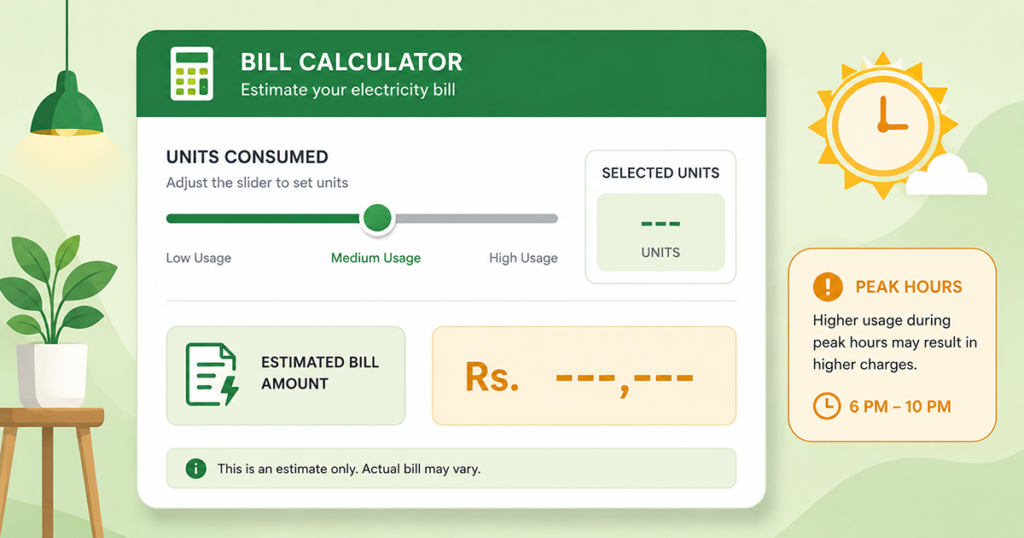
Before your next MEPCO bill arrives, using a reliable MEPCO bill calculator is the best way to estimate your monthly electricity cost. Rather than guessing your total amount, an accurate mepco bill calculator takes into account your exact unit consumption and slab rates. Understanding how these tariffs work helps you get the most precise estimate from any online bill calculator for MEPCO connections.
How MEPCO’s Slab-Based Tariff Works
Rather than charging one flat rate per unit, MEPCO — like every DISCO in Pakistan — applies a tiered slab structure:
- Consumers are grouped into protected and unprotected domestic categories, based on average monthly consumption over a rolling period (commonly a six-month average around a defined unit threshold).
- Within each category, units are billed in blocks (for example, the first block at the lowest rate, the next block at a higher rate, and so on), meaning your average rate per unit rises as total consumption increases.
- Commercial and industrial consumers follow a separate tariff schedule that often includes fixed monthly charges and, for larger loads, demand-based charges tied to peak consumption rather than total units alone.
Using a MEPCO Bill Calculator to Estimate Your Costs
While manual calculations are possible, an online MEPCO bill calculator simplifies the entire process. By entering your consumed units into the mepco bill calculator tool, you can quickly see how your overall charges are distributed across different slabs and surcharges.
Peak Hours and How They Affect Your Bill
Peak hours mepco refers to the time window during the day when overall electricity demand — and therefore system strain — is highest, typically covering the evening hours when households and businesses draw power simultaneously. A few practical points:
- On tariffs with time-of-use components (mainly larger commercial and industrial connections), electricity drawn during peak hours is billed at a higher rate than off-peak consumption.
- For most standard domestic consumers on a flat slab tariff, peak hours affect system load and load-shedding risk more directly than your bill’s per-unit rate, but shifting heavy appliance use outside peak hours still reduces strain-related outages in your area.
- Regardless of tariff type, avoiding simultaneous heavy-appliance use during peak hours (air conditioners, irons, water heaters, and washing machines running together) reduces your risk of tripping a shared transformer or feeder, which indirectly reduces outage frequency.
What a MEPCO Bill Calculator Tool Should Actually Ask For
Because of the slab-and-category structure above, an accurate MEPCO bill calculator needs more than just a single “units” field. At minimum, a meaningful estimate requires:
- Your consumer category (domestic protected/unprotected, commercial, industrial, agricultural)
- Your expected units consumed for the billing period
- Whether you’re already near a slab boundary based on recent months
- The current NEPRA-notified base rate used by the bill calculator for your category, since this is the piece that changes most often
Treat any online bill calculator — including simplified tools — as a planning estimate, not a guarantee, and always reconcile against the actual bill once it’s issued.
Conclusion
A reliable MEPCO bill calculator estimate comes from understanding your own recent bills. Before relying on an online bill calculator, make sure you understand your consumer category, track your slab, watch for FPA and QTR movements, and use peak-hour awareness mainly to reduce outage risk rather than expecting a dramatic bill change unless you’re on a time-of-use commercial or industrial tariff. For your exact current bill, always use our MEPCO online bill check with your 14-digit reference number.
Frequently Asked Questions
What is MEPCO's current unit price?
It depends on your consumer category and current billing slab, and it’s revised periodically through NEPRA’s tariff notifications. Check your latest bill’s energy-charge line or NEPRA’s official tariff notice for the exact current rate rather than relying on a fixed figure quoted online.
How accurate is an online MEPCO bill calculator?
Most online MEPCO bill calculators provide a close estimate based on NEPRA’s basic slab rates. However, your actual bill may slightly vary due to real-time Fuel Price Adjustments (FPA) and taxes.
What are MEPCO's peak hours?
Peak hours are the evening window when electricity demand is highest across MEPCO’s network. They mainly affect time-of-use billing for larger commercial/industrial consumers, and system load/outage risk for everyone else.
Does using less electricity during peak hours lower my bill directly?
For consumers on a standard flat domestic slab tariff, the direct billing effect is limited; the bigger benefit is reduced load-shedding risk. For time-of-use commercial/industrial tariffs, peak-hour usage is billed at a higher rate, so shifting load does reduce the bill directly.
Why did my bill increase even though my units stayed the same?
Almost always due to a Fuel Price Adjustment or Quarterly Tariff Adjustment applied by NEPRA that billing cycle — not an error in your usage or meter reading.
How can I calculate my MEPCO bill before it's issued?
You can use our digital bill calculator tool above or apply your recent blended unit rate to your current unit consumption to generate an accurate pre-bill estimate.